Mechanical Foam Breaker for Soymilk Production
Soymilk foams heavily during boiling, homogenising and tank storage — the protein-rich foam overflows, carries product away and traps air in filling lines. Chemical defoamers leave residue in a product consumers expect to be clean.
What foam actually costs you
- ▲Boiling and homogenising foam overflows the tank — visible product loss in every batch
- ▲Foam in filling lines causes under-filled packs and inconsistent volumes
- ▲Chemical defoamer residue stays in the product and must be declared on the label
- ▲Sanitary tanks demand surfaces that are easy to clean and safe for food contact
How the DP Series fixes it
The DP Series mounts on soymilk tanks and filling lines, draws foam into a centrifugal chamber and breaks it mechanically — nothing is added to your product, nothing must be declared. 316L wetted parts, Ra < 0.5 µm inside finish.
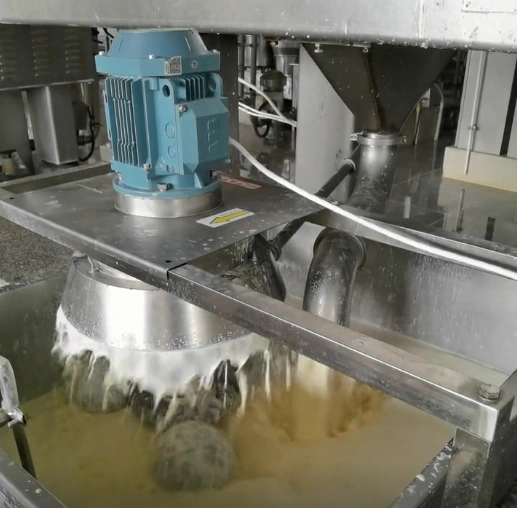
Hygienic flange mounting on closed tanks; food-grade wetted materials.
Discuss your soymilk tank size and foam rateHow a mechanical foam breaker fits your process
How soymilk foam forms
Soymilk foam starts with two compounds: saponins, which lower surface tension and stabilise bubbles, and proteins, which build a elastic film around each bubble. During boiling, the steam expands the bubbles faster than they collapse — this is the false-boil effect that makes tanks overflow without warning. Homogenisation then breaks fat into fine droplets that further stabilise the foam. The result is a persistent foam blanket that survives storage and reappears in filling lines, where it traps air and under-fills packs.
Where foam hurts in a soymilk line
The critical points are the cooking tank, the homogeniser surge tank, storage tanks and the filling line. In the cooking tank, false-boil overflow loses product and creates a cleaning burden. In storage, foam traps air and oxidises the soymilk. In filling, foam causes under-fills and inconsistent pack volumes that trigger rejection. A DP Series unit on each foam-critical tank, or on the common surge tank, removes the foam at the source.
Sizing for soymilk production
Sizing starts from tank volume and line speed. A 5,000 L cooking tank with a 3,000 L/h line typically needs a unit matched to the peak foam rate during boiling — the DP Series covers 1 – 50,000 L/h. Send us your tank sizes and production rate and we will confirm the right model and mounting.
DP foam breaker model range for Soymilk
All DP models use the same mechanical defoaming principle — choose by your foam overflow rate. Size up one step if your rate is near the upper limit.
| DP foam breaker model | Power (kW) | Speed (rpm) | Defoaming capacity (m³/h) |
|---|---|---|---|
| DP-1 | 0.75 | 2,800 | 5 |
| DP-2 | 1.1 | 2,850 | 10 |
| DP-3 | 1.5 | 2,850 | 15 |
| DP-4 | 2.2 | 2,850 | 20 |
| DP-5 | 3 | 2,850 | 30 |
| DP-6 | 4 | 2,850 | 40 |
| DP-7 | 5.5 | 2,850 | 60 |
| DP-8 | 7.5 | 2,850 | 80 |
| DP-9 | 11 | 2,900 | 100 |
| DP-10 | 15 | 2,900 | 150 |
| DP-11 | 22 | 2,900 | 200 |
| DP-12 | 30 | 2,900 | 300 |
| DP-12S | 37 | 2,900 | 500 |
Mechanical foam breaker sizing calculator
Enter your tank dimensions and foam overflow rate. This calculator recommends the smallest DP mechanical defoaming machine that handles your process.
This application runs on the DP Series mechanical foam breaker — see the full model range, technical specifications, sizing calculator and wetted materials.
Why a mechanical foam breaker beats chemical defoamers here
Mechanical foam breaker (DP Series)
- • No chemical dosing — zero interference with your process chemistry
- • One-time purchase, 12-month warranty, 10-year service life
- • No ongoing anti-foam agent cost — payback in 6-12 months
- • No residue in product or effluent — food & pharma safe
- • Centrifugal principle: instant foam breaking at the surface
Chemical defoamer dosing
- • Recurring chemical cost every month
- • Can alter product flavour, colour or reaction chemistry
- • Residue in effluent increases wastewater load
- • Dosing pump maintenance and inventory
- • Overdosing kills the foam you actually need
Frequently asked questions
Why does soymilk foam so much?
Soymilk is rich in saponins and proteins, which stabilise the air bubbles formed during boiling and homogenising. The foam can even create a false-boil effect that overflows the tank.
Does the foam breaker add anything to my soymilk?
No. The DP Series breaks foam mechanically and returns the liquid to the tank. No chemicals, no residue — nothing extra in the final product and nothing to declare on the label.
Can I install it on my existing soymilk line?
Yes. The DP-F model flanges onto closed tanks and the hygienic design connects into standard stainless piping and tank ports, so it fits existing soymilk cooking, homogenising and filling lines.
How is it cleaned between batches?
The unit is built for hygienic service — 316L wetted parts, Ra < 0.5 µm inside finish — and supports the wash-down and CIP routines used in soymilk plants.
Will it handle the false-boil foam during cooking?
Yes. That sudden, violent foam is exactly the case the DP Series is designed for — it destroys foam as fast as it forms, so the tank never overflows.
What capacity do I need for a soymilk line?
It depends on tank volume and production rate. The DP Series covers 1 – 50,000 L/h. Tell us your tank size and line speed and we will recommend the right model.
Foam control in related processes
Get a quote for your foam problem
Tell us your application, tank volume and foam rate — we will recommend the right DP Series model and quote within one working day.